Unofficial fan page · not affiliated with the filmmakers
Niu Lai It made $1,000 in nine days. Then China stopped laughing long enough to buy tickets.
牛来 · English title Here Comes the Ox · animation · 86 minutes · released in China August 5, 2026 · Singapore September 1, 2026 · entire crew: a director and his mother
Last updated . This page tracks new territories as they are announced.
This is the question everyone arrives with, so here it is first. The Chinese theatrical run is over. Singapore is next, and it is the only confirmed overseas date so far.
Territory
Status
Date
Notes
Mainland China
Ended
Aug 5 – Aug 17, 2026
Opened in 245 cinemas, peaked at 359 daily showings
Singapore
Confirmed
September 1, 2026
First overseas territory, released by Encore Films
Southeast & East Asia
Scheduling
TBA
Six language versions prepared, dates rolling out
Hong Kong
In talks
TBA
Broadway Cinematheque replied "in talks" Aug 19, per HK01
United States / Canada
None
—
No screenings, no announced date
Streaming
None
—
No platform announced, no subtitled release online
Singapore distributor Encore Films holds exclusive worldwide rights outside mainland China. To cover Southeast Asian and East Asian markets, the film has been prepared in six versions: Mandarin, Cantonese, English, Korean, Japanese and Thai. Two people spent five years and a few thousand yuan making this in an apartment in Dalian. It now has six dub tracks.
For availability everywhere else, and for what the uploads circulating online actually are, see where to watch Niu Lai.
About the United States, since this is where the confusion is. American readers have seen a lot of Niu Lai coverage: Bloomberg, Gizmodo, the animation trade Cartoon Brew. A single clip passed six million views on X. TikTok and ResetEra ran with it for days. All of that is real, and none of it is a release. No American cinema has ever booked this film, and no North American date exists. Being talked about in a country is not the same as being playable in it.
One more thread is worth naming, because it is the reason the film travelled at all. Anything can be generated on demand now, and overseas audiences read Niu Lai as proof of the opposite: it is bad in specific, human, unrepeatable ways. Gizmodo put the anti-AI framing straight in its headline. Two people, five years, a few thousand yuan. That sentence lands harder abroad than the animation ever could.
Overseas timeline
Aug 14Clips escape the Chinese internet; reupload accounts on X start compounding
Aug 15Bloomberg becomes the first major international outlet to report it: online scorn is filling seats
Aug 16Overseas attention overtakes the domestic wave; one clip passes six million views on X, TikTok follows
Aug 17Gizmodo frames it as an anti-AI phenomenon; hundreds of ResetEra replies; Cartoon Brew covers the box office
Aug 18Encore Films takes exclusive worldwide rights outside mainland China; six language versions confirmed
Aug 19Singapore's September 1 date spreads; coverage widens to outlets including The National
Sept 1Singapore opens. The first time this film screens outside China
TBARemaining Southeast and East Asian markets. Nothing announced for streaming or North America
Dates reflect public reporting by the outlets and distributors named. Showtimes are set by local exhibitors.
How it got here
The Story
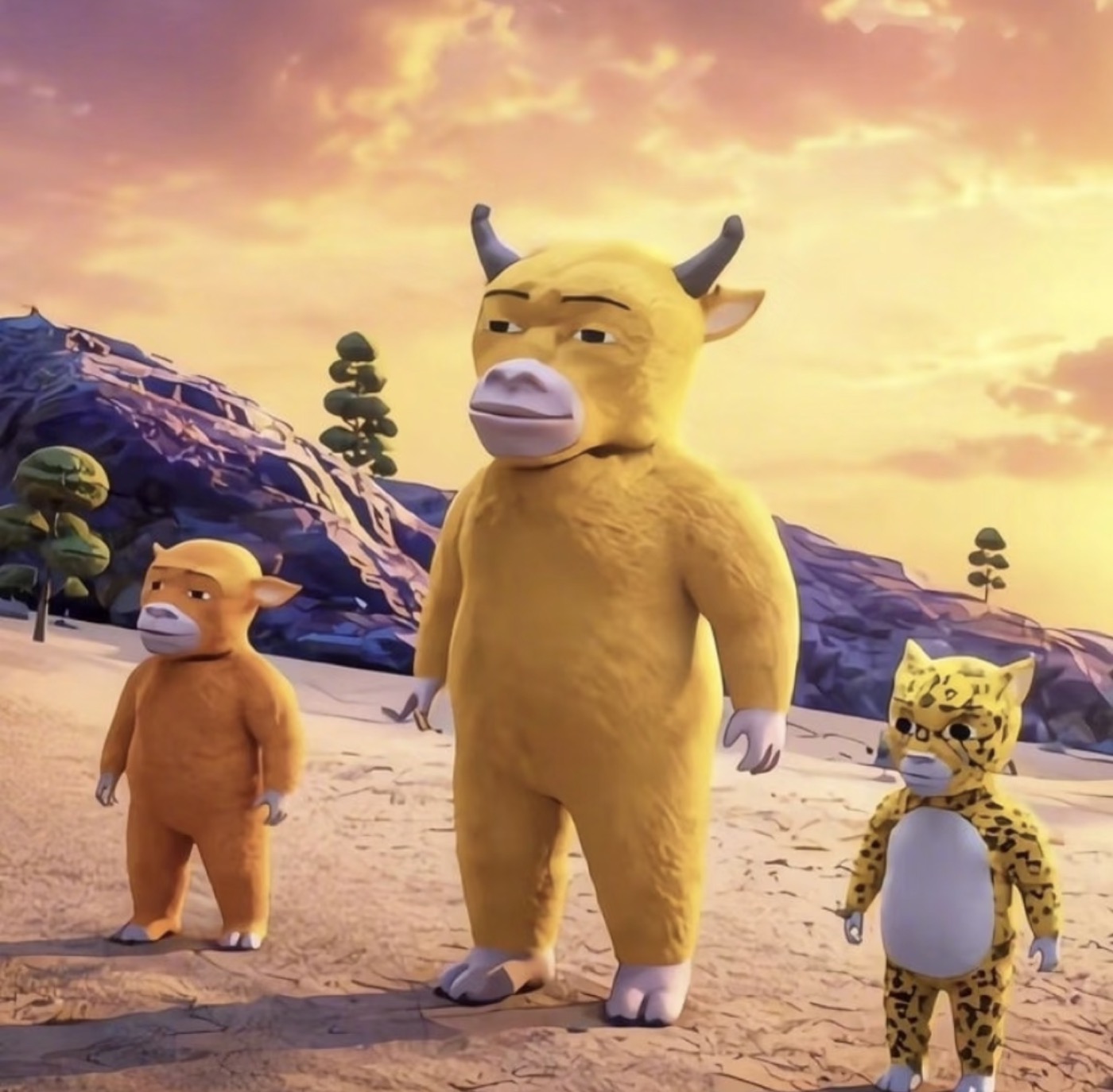
On August 5, 2026, an animated film called Niu Lai opened quietly in 245 Chinese cinemas. No trailer, no press tour, no interviews. The only marketing asset was a single ink-wash poster of a calf, and it was genuinely lovely. The film came from a Dalian company that had been a home-renovation contractor until 2021. It took more than five years and a few thousand yuan to make. Director Xin Yumeng did the animation. His mother, Sun Lifang, wrote the script, voiced the characters, and wrote and sang the closing song.
Nobody came. Nine days, 236 tickets, ¥7,169, the lowest for any animated film in Chinese cinemas that year. By August 14 only four screens in the country were still showing it.
Then clips leaked. Audiences discovered the distance between that ink-wash poster and the actual film: stiff rigs, geometry clipping through itself, dialogue looping into the surreal. "Worse than AI" went everywhere. And the mockery did something nobody planned. The louder it got, the more people wanted to see it with their own eyes.
Aug 13¥7,169 after nine days; four screens left nationwide
Aug 14Clips go viral, "worse than AI" trends, exhibitors start adding showings back
Aug 15359 showings in one day, ¥46,000 in presales, Bloomberg reports, one viewer drives 30km "to witness history"
Aug 16Passes ¥10 million and enters 2026's top ten domestic animated films; ox-named A-shares start moving
Aug 17The director announces the run is over. Half the cinemas say they never got the notice and keep screening it
Aug 18Passes ¥20 million; Encore Films takes overseas rights
Sept 1Singapore opens
A few thousand yuan in, tens of millions out. Niu Lai is now one of the highest return-on-investment films in Chinese cinema history. Not the best one. Possibly the strangest.
The abstract archive
Ten Frames
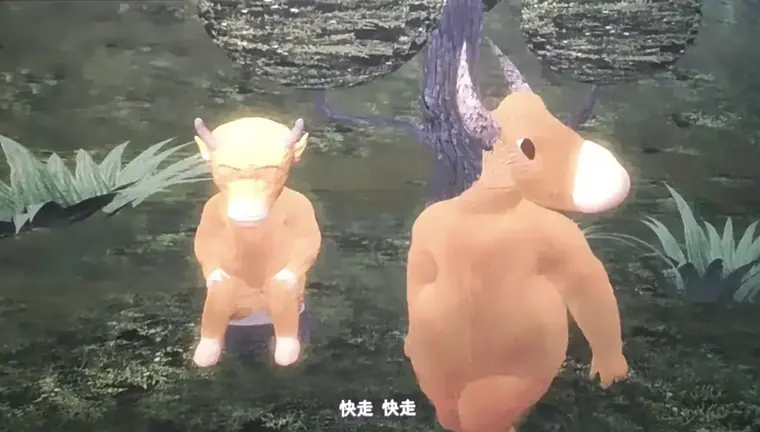
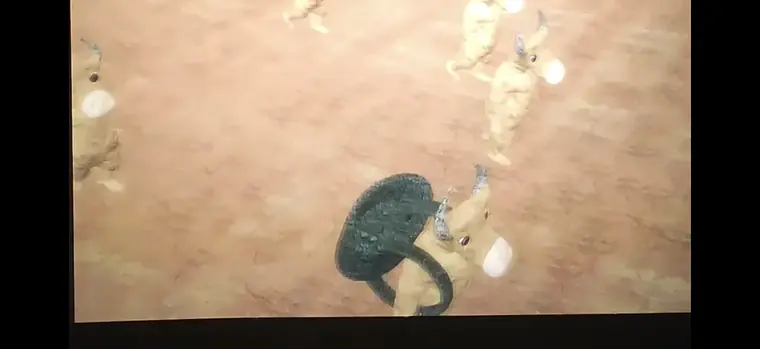
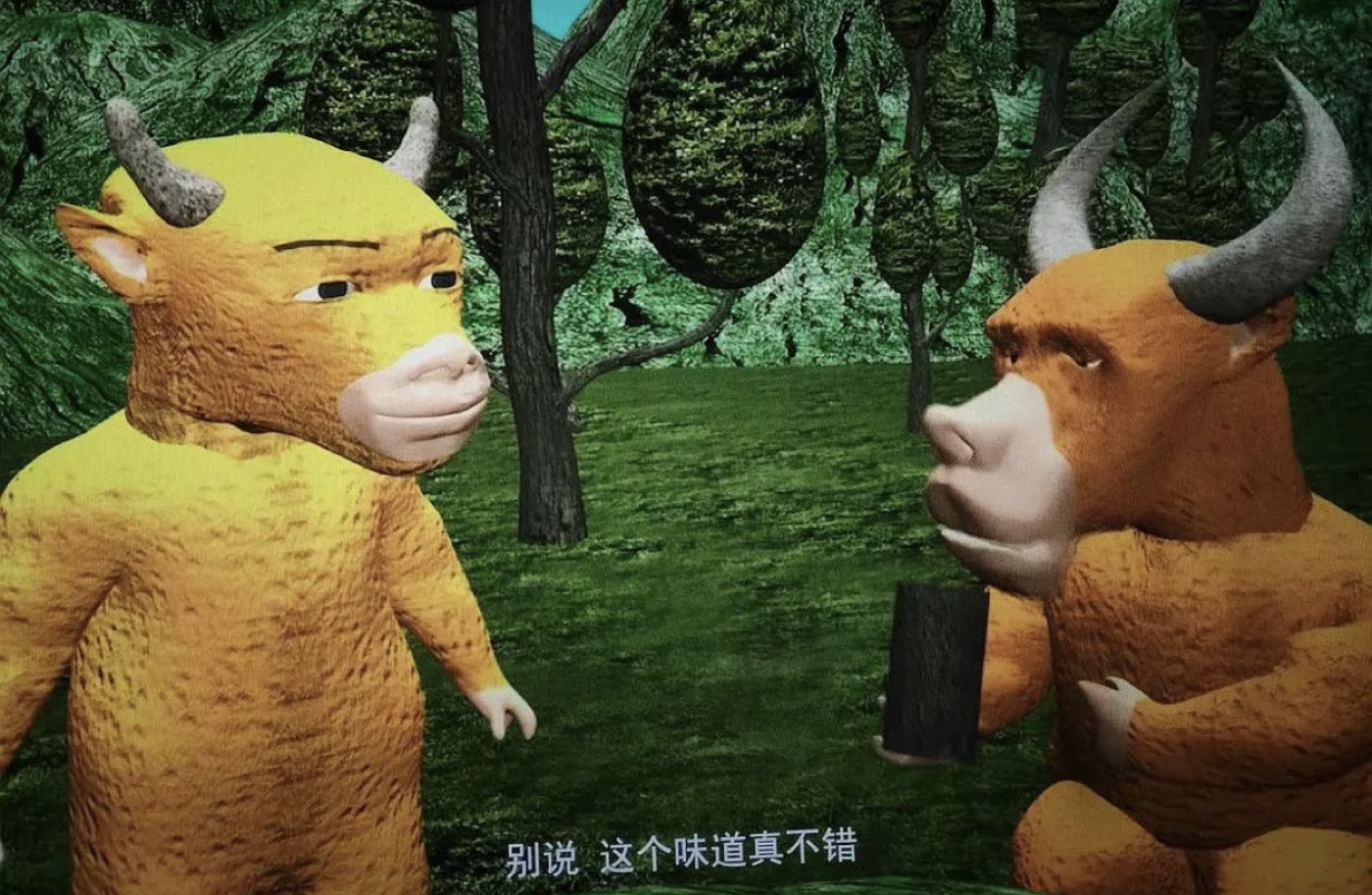
China's run is over and Singapore has not opened yet. Until then, these ten frames are the closest thing to seeing it. Full screen recommended. Expectations not.
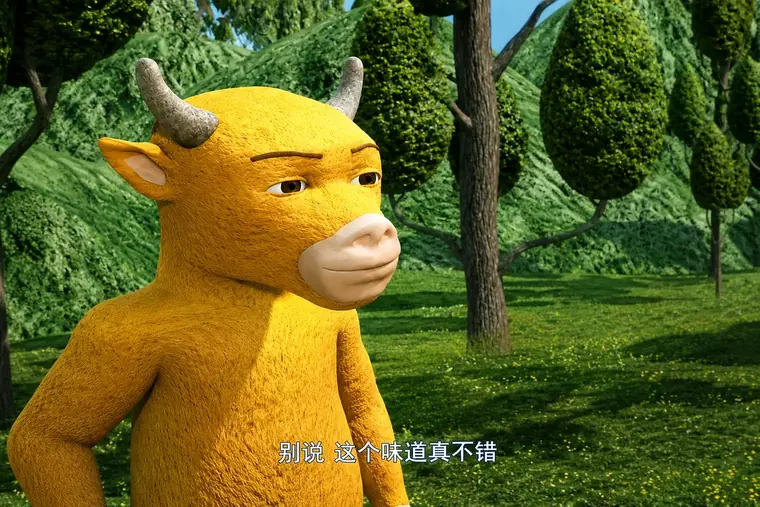
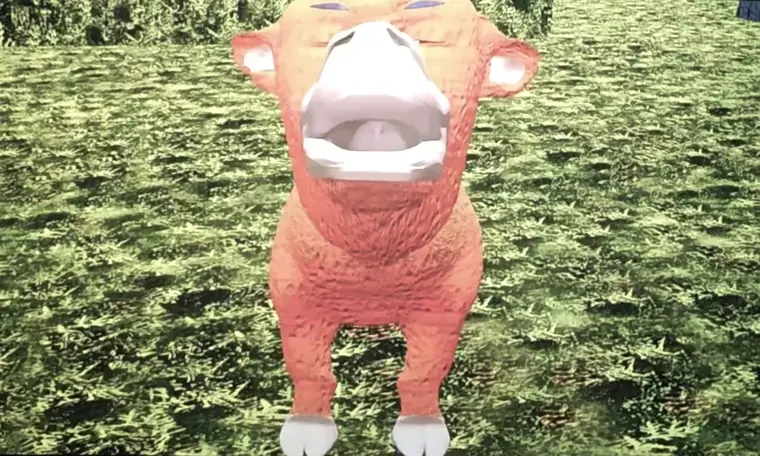
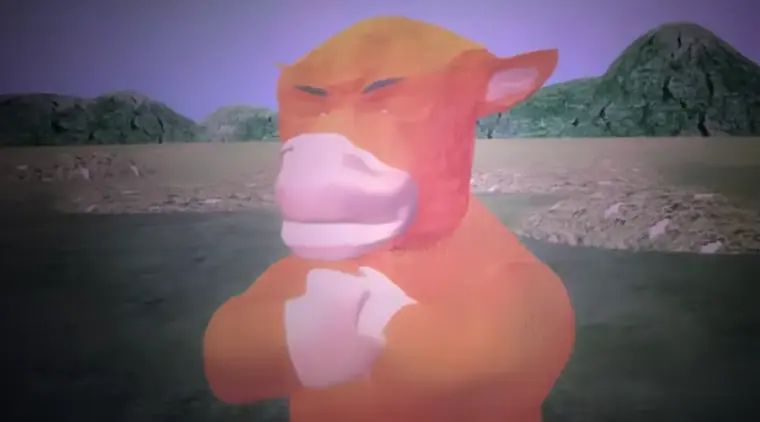
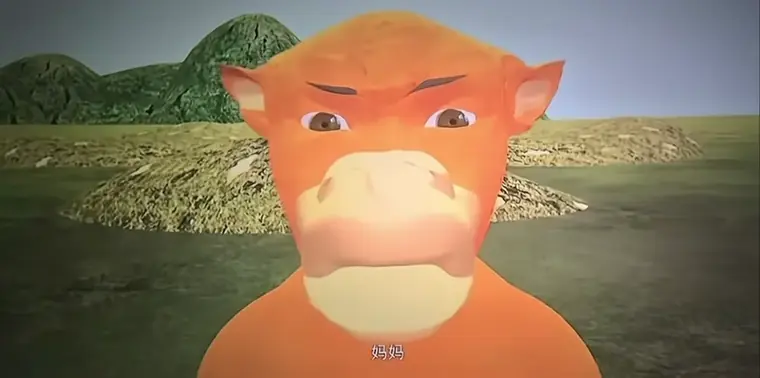
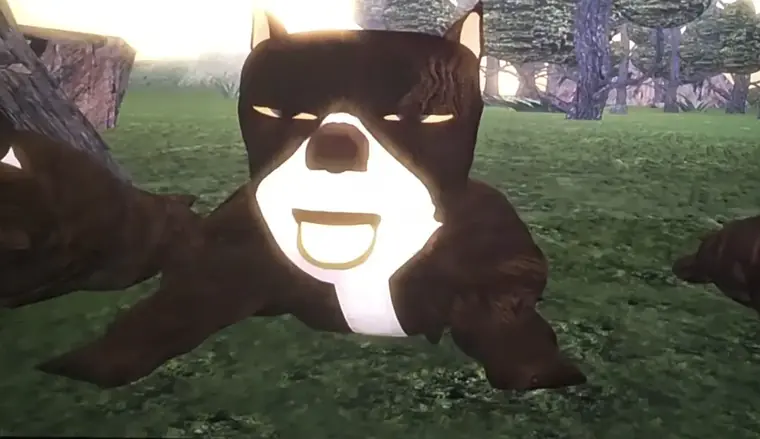
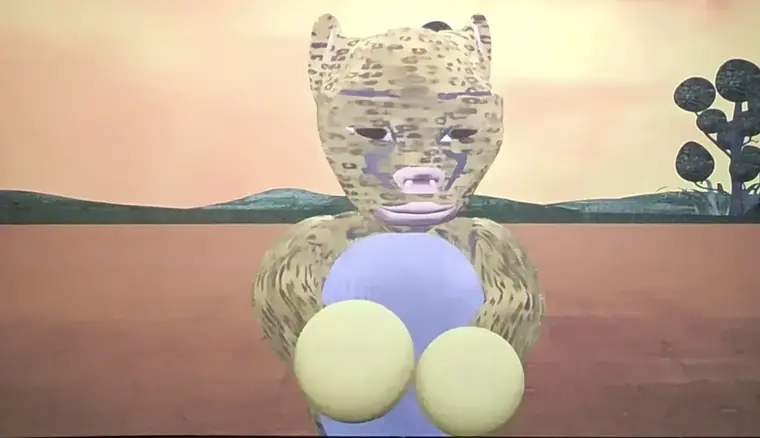
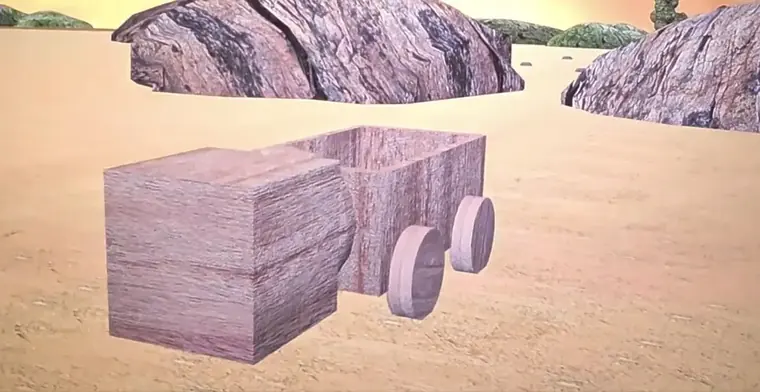
"Not bad — this actually tastes pretty good." The most quoted line in the film, now used as a password.The protagonist is emoting. Yes, that is emotion.Lighting, framing and color. Three departments, no meetings.This is a close-up.Enter Baola the panther. He is the good guy.Nobody has yet established what the two spheres are.A rock.A cart."Go, go." The plot is advancing.An establishing shot. Believed to be a scene.
Frames captured from the film. Copyright Dalian Jingyuan Culture Film and Television Media Co., Ltd.; reproduced here for review and commentary. Captures sourced from viewer uploads on Douban.
Two deeper reads
Deep Dives
Where to watch Niu LaiSingapore opens September 1, status by territory, and why there is still no legal stream
In Mandarin, 牛来 (niú lái) reads as "the ox arrives". It also reads as 牛市来了, "the bull market is here". To anyone holding Chinese equities in August 2026, there was only ever one reading. Between August 15 and 17, A-share stocks with 牛 in their names moved together, and financial media started calling them the Niu Lai concept stocks:
Company
Ticker
Actual business
Mid-August
Luoniushan
000735
Pig farming
Hit daily limit up
Jinniu Chemical
600722
Chemicals
Trended on hot-stock lists
Bull Group
603195
Power sockets
Top of hot-stock lists
Tongniu Information
300895
IT services
Top of hot-stock lists
These four companies have two things in common: an ox in the name, and no connection whatsoever to a cartoon about a calf. This is not investment advice. Strictly speaking it is not even a concept.
In stock forums people posted photos of their Niu Lai ticket stubs with captions along the lines of: I bought the ticket, so the bull market can show up now. Others arranged stubs into the shape of a limit-up candle. A ¥30 cinema ticket became an offering. One chief strategist at a brokerage noted that the phenomenon was more interesting than the film: when expectations are on the floor, anything unexpected counts as good news.
Bad enough, for long enough, becomes an omen.
Why millions bought tickets to something they were mocking
Auspicious Words
To explain this you need 讨口彩 — the practice of collecting auspicious-sounding words. Phone numbers with 8 cost more, because 八 sounds like 发, to prosper. Fish appears at New Year dinner because 鱼 sounds like 余, surplus. You never gift a clock, because 送钟 sounds like 送终, attending a funeral. The Chinese attachment to lucky homophones does not care whether the object is a phone number or a movie ticket.
A Niu Lai ticket sits perfectly inside that logic: ¥30, 86 minutes of abstraction, and one loud auspicious phrase attached — the ox is coming. The ox in the zodiac already stands for patient effort that pays off late, and 牛气冲天 is a standard blessing for a run of good fortune. So, strictly speaking, Chinese audiences were not watching a film. They were touching a lucky coin.
Has your bull market arrived?
Posting a ticket stub as a wish is the new folk practice. Drawing a fortune stick and asking the god of wealth directly is the old one. You can do it online, free.
Draw a fortune stick
kaucim.ai · Wong Tai Sin fortune sticks · make a wish, get an answer
The plot, in full
Spoilers
Complete spoilers. China's run is over and Singapore opens September 1, so for the next couple of weeks this is as close as most people can get.
Niu Lai is a timid calf living under the protection of his mother and the herd. One day he follows a skylark and falls into a long dream. On the dream grassland a spirit snake warns him that true safety does not exist anywhere, and he befriends Baola, a righteous panther the herd has cast out. Wolves attack; his mother dies covering his escape. Niu Lai takes on responsibility and begins resisting the humans destroying the forest. When he wakes, every event of the dream dissolves, but the courage stays. He returns to his father's herd knowing what it means to stand in front of someone.
On paper, a competent coming-of-age fable. On screen, 86 minutes that audiences described as an out-of-body experience. The gap between those two sentences is the entire story.
A softer reading
After the Noise
Once the pile-on thinned out, a second reaction appeared. People who actually went reported something closer to a group event than a screening: 1am showings selling out, an entire room laughing along with the dialogue for an hour, applause at the end. And among the people who laughed hardest, a portion got quietly ambushed by the closing song. Sun Lifang wrote, composed and sang it herself. The melody is simple. A lot of viewers said it stopped being funny somewhere in the second verse.
Some audiences also read the looping dialogue and unplaceable camera choices as a different way of perceiving a story, and then noticed the film and its making might be the same story twice: a calf learns in a dream to face the world alone, while a mother and son spend five years in the real one finishing that dream. Her voice holds the floor; he walks the road. Faced with a nationwide pile-on, the director's response was to accept it. In a year when anything can be mass-produced by a machine, a lot of people revalued that kind of clumsiness.
This space is for rent
Want to put something in front of this audience?
A steady stream of people land on this page every day because of two Chinese characters. If you have something they should see, get in touch.
Soon. Singapore opens September 1, 2026 and is the first overseas territory. Encore Films holds exclusive worldwide rights outside mainland China and has prepared Mandarin, Cantonese, English, Korean, Japanese and Thai versions for Southeast Asian and East Asian markets. Other territories are being scheduled.
Is it coming to the United States?
Not as of August 19, 2026. There is heavy US coverage — Bloomberg, Gizmodo, Cartoon Brew, six million views on a single X clip, days of TikTok and ResetEra discussion — but no American cinema has booked it and no North American date has been announced. The announced footprint is Southeast Asia and East Asia.
Is it streaming anywhere?
No. No platform has announced it and there is no legitimate subtitled version online. Anything claiming otherwise is a pirated copy.
Is Niu Lai on YouTube?
Full uploads keep appearing on YouTube and TikTok, some with English subtitles. They are unauthorised rips, and they get taken down and reposted on a loop, so a link that worked yesterday often will not today. There is no official upload and no licensed streaming version anywhere as of August 19, 2026.
How much did Niu Lai cost to make?
Reported at a few thousand yuan — roughly US$400 to US$500 by most accounts — spent across more than five years. There was no studio, no outsourced animation and no marketing spend beyond a single poster. Director Xin Yumeng did the animation; his mother Sun Lifang wrote it, voiced it and sang the end-credits song.
Is it actually that bad?
Visually, yes: low-poly models, geometry clipping, stiff movement. But "bad" does not explain why people went. What happened in those rooms looked more like a group activity — sold-out 1am showings, an hour of collective laughter, applause on the way out — and once you add two people, five years and a budget of a few thousand yuan, a lot of viewers started treating it as folk craft. Mockery and affection turned out to be the same feeling wearing two faces.
Who are the two people who made it?
Director Xin Yumeng and screenwriter Sun Lifang, his mother. They are the only credited creatives and the entire voice cast, and Sun also wrote, composed and performed the theme song. The production company, Dalian Jingyuan, was founded in 2016 as a home-renovation contractor and only pivoted to media in July 2021.
What did it cost, and what did it make?
Reported production cost is a few thousand yuan, spent over five years. It made ¥7,169 in its first nine days, then passed ¥20 million after going viral (as of August 18, 2026), landing in 2026's top ten domestic animated films. The return on investment is among the highest in Chinese film history.
Why was it pulled from cinemas?
On August 16 the director announced the theatrical run was ending, effective August 17. Enforcement was chaotic: cinemas in several cities said they never received a formal notice and kept screening it, while some Dalian cinemas did pull it, reportedly because the production was rough enough to "affect the image of Dalian". The confusion generated its own news cycle.
What does the title mean?
Literally "the ox is coming", which is also the calf's name. But 牛 carries three senses at once in Mandarin: the animal, the slang for awesome, and the bull in bull market. So the title reads simultaneously as "here comes the calf", "things are about to be great" and "the bull market is here". That third reading is why a cartoon ended up in stock forums.